

AI and Challenges in Workforce Development
tl;dr
AI is transforming the workplace. This is starting to change our organizational models from pyramids (with a large base of entry level staff) to diamonds (with a proportionally bigger middle).
Talent Pipelines are Weakening. Pressure increases on talent development pipelines as the entry level shrinks. The cognitive load on the mid-level staff increases, which means we need more ways of getting entry level people not just skills but better judgment and taste in ways not dependent on years of low level work (that is now becoming increasingly automated).
Take Deliberate Action. We need to take explicit actions to deal with this, both structurally using different professional development activities, and embedding into tooling so AI is not just a means of automation but is also a means of coaching people.
Many workforce and professional development pipelines that exist today, and certainly from before the advent of wider automation due to AI, will change significantly. Our current broad-based pyramid-like structure of a large intake of entry-level workers will, in many professions or roles, be replaced with something more like a diamond, where there are less entry level roles. This will create multiple challenges in organizations, not least to change the way we develop people to get to the necessary skills that previously the years of working up from the entry-level prepared them for. We have an immediate choice to start preparing for this before we face a skills crisis when our talent pipeline becomes fractured in a few years.
Before we go into this, let me share an experience. Last year I came across two professional services firms and how they were managing this. Both were, and still are by all accounts, wonderful companies doing great things for their clients. Both are, like many such firms, adopting AI thoughtfully to transform their business activities to reduce cost, improve customer service, and increase efficiency to scale what they do to a broader client base. Entry-level roles are becoming more disrupted than others, given much of the AI benefits accrued to more accomplished professionals, despite some of the effects that the less experienced professionals are getting an apparent skills boost from the use of AI. Having observed this I asked both organizations whether they were worried about the talent pipeline fracturing given that historical skills development for the junior workforce was heavily centered on learning the ropes by executing the very "grunt-work" that AI was, rightly, automating away. One organization was aware of this but wasn’t doing much about it. The other organization viewed it as an almost existential long-term risk. They are already taking steps to introduce new forms of apprenticeship and skills development alongside how junior staff were using AI so that the skills and judgement they need to rely on in more senior or specialized roles were explicitly cultivated. In 3-5 years one may well have a severe talent break and the other likely will not.
So, we’ll have fewer entry level roles, the same need (if not more) in the middle, and the same need, albeit with expanded skills and scope at the top. The big question is how do we deal with this and it can’t be just everyone poaching everyone’s middle. By optimizing the present, unless addressed, organizations are inadvertently dismantling the machinery that builds their future. Of course, this doesn't mean there is no future for the former entry-level, rather it means in many cases that the new entry-level is directly into the mid-layer according to our old hierarchy.
Consequence 1: Organizations Move from Pyramid to Diamond

The senior/expert level continues as some combination of expert execution, executive leadership, macro-strategy, strategic customer relationships, and the management of risk. This level will need to focus more on the development of professionals in different ways across the organization and how to cultivate the organization’s human, digital and agentic effectiveness. This will include plenty of attention on the relative allocation of human and computational resources.
The mid-level is full of people at varying degrees of seniority and expertise that becomes a huge orchestration engine. Here is where high-friction, complex problem-solving and AI operational validation exist.
The entry-level is where fewer remaining junior roles transition from entry to the mid-level at a necessary faster pace. In many respects this level is even more tending to the machines like reviewing machine-generated work for flaws.
This relative expansion of the middle creates incredible cognitive load because most of the routine (low ambiguity, high repetition) work is automated leaving a higher concentration of complex or otherwise difficult activities to be handled here.
Consequence 2: Less Innate Apprenticeship and Ambient Training
The established mid-level to senior workforce that was junior before or in the early stages of AI, developed skills through training and professional development. This is especially so in many professional occupations like medicine, law, engineering, and more. But as I think we all experienced in all roles, a lot of the training was on the job from doing, in many cases, quite mundane activities. This could be from coding up “easy” software, test cases, eventually ramping up to more critical systems, or in operations dealing with tickets and diagnosing routine problems, to the help desk and other support roles. In all of this, and in other roles and professions, we developed a feel for what was normal, and an intuition of what the likely root cause of some even unexpected conditions. In other fields of professional services (consulting, accounting, banking, law for example) a lot of the early stage career work is producing content, reviewing content, performing analysis all of which imbued a lot of knowledge, especially when iteratively improving the work under the careful (perhaps painful) supervision of a mid-level practitioner or leader who themself had been through this type of personal development. Collectively all of this helped us develop judgment and taste for what is right and what might be expected by customers.
While automating all of this is inevitable and mostly correct it does create a dangerous gap in how such intuition is developed. Consider security operations, a Tier 1 analyst historically learned the baseline of "normal" through manual triage or by checking and validating SOAR outcomes. Even when they or more senior level staff mainly look at curated narratives of incidents, events, threats etc., there was still much detail to cross check in certain cases. If they’d never seen the thousands of micro-events, logs, false positives, traces, false negatives and more, they will lack the foundational intuition to spot a subtle anomaly when the automated system fails. By removing the pressure of messy, early-career work, organizations are potentially creating a fragile workforce if they don’t explicitly address that.
Consequence 3: Agent Hierarchy - from Chatbots to Principals
AI in the enterprise is moving beyond the initial wave of chatbots, through automating tasks, to transforming business processes. In effect we’re moving up a hierarchy of autonomy. This recent a16z blog summed it up nicely:
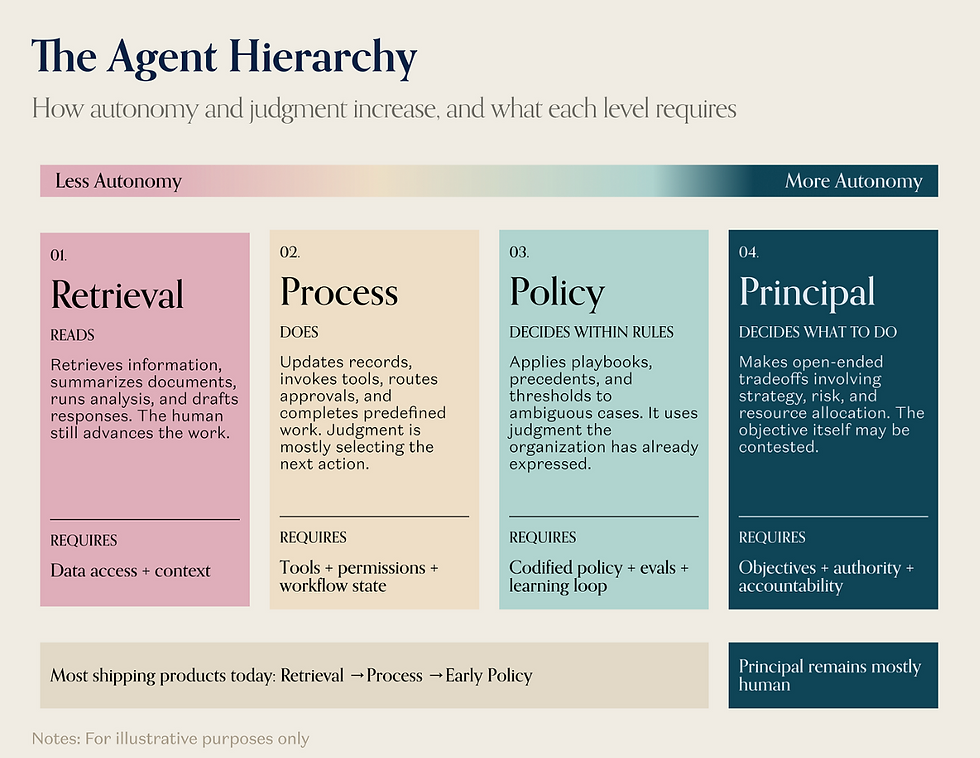
Retrieval agents "read" and summarize. They find information and draft responses, but the human still advances all the work. Process Agents "do" rule-based work. They update records and route approvals using limited judgment to select the next action. Policy Agents "decide within rules", applying an organization's playbooks and precedents to ambiguous cases. Principal Agents "decide what to do", making high-stakes judgment calls regarding strategy, risk, and resource allocation where objectives may be contested.
So, what steps can we take? Here are some I’ve observed or otherwise think might be useful. I’m sure there are many more and better options as we progress.
Action 1: Move from Incidental to Deliberate Professional Development
Organizations that view AI only as a cost-cutting tool for entry-level headcount are effectively eating their seed corn. By removing the foundational work, they are dismantling the environment that produces the next generation of experts and so this needs to be more deliberately recreated.
If the first three years of professional exposure are automated, expertise must be manufactured through "simulated apprenticeships" or other rotations. This is especially important in roles that don’t have the surrounding structured professional development that leads to actual strong qualifications, for example: professional engineer, lawyer, doctor, accountant, and so on.
The use of ranges, simulations or other training environments will become more vital, including training in environments where automation is deliberately compromised in some way. From this, we can create rigorous synthetic environments that force junior staff to deconstruct how an AI reached a conclusion rather than simply accepting the output.
Action 2: Redefine Entry-Level Hiring Criteria
Interviews and hiring rubrics must shift away from testing rote memory or basic data gathering. Instead, organizations must hire for AI fluency, critical thinking, and system-level orchestration. Assessments should provide candidates with AI-generated outputs and test their ability to identify hallucinations, correct logical flaws, and refine prompts. We should likely place a fresh premium on first-principles knowledge, that which will remain constant despite technology or other changes.
Let’s be more specific about what this might look like in cybersecurity. Each of the following follows the same structure: what the implicit apprenticeship used to be, what automation removed, and what deliberately replaces it.
Detection engineering (replacing alert triage). The old on-ramp was clearing a queue until you had seen enough normal to recognize abnormalities. Replace it by giving each junior ownership of a narrow detection surface: they write the rule, write the test, review machine proposed detections before they ship, and track the precision and recall of their own detections over ninety days. The transferable skill is reviewing generated work against a standard, which is the actual mid-level job they are heading into.
Exploitability adjudication (replacing patch queue work). Juniors used to learn the estate, who owns what, what might break when you patch it, which "critical" finding is likely unreachable. Scoring and routing are now automated. Give juniors a sampled subset of the automated prioritization and require them to prove or disprove reachability or the criticality rating, then publish the false-positive rate of the scoring model each quarter. They learn the estate and the organization learns how much to trust its own ranking.
Variant analysis (replacing first-pass code review). Applying security training meant reading lots of bad code and running commodity tools. Now the finding and often the fix are generated. Replace it with adversarial review. Hand the junior an AI generated remediation and require them to find the case where it is incomplete or introduces a new defect, then write the variant analysis that finds the same class elsewhere in the codebase. Root-cause and class-elimination thinking is precisely the judgment that used to take many years to acquire.
Entitlement archaeology (replacing access-request processing). Identity and access juniors learned entitlement models, and the organization chart along with them, by processing requests and running recertifications. Recommenders now propose least privilege directly. Instead, assign juniors a high-risk role or application and require them to reconstruct why each permission exists, who would notice if it were removed, and then run the removal. This teaches blast radius and organizational reality.
Control-failure post-mortems (replacing evidence gathering). In risk and assurance the entry-level work was collecting evidence and drafting control narratives, which is now automatable. Replace it by putting juniors on failures. Take a control that was documented as effective and establish why it was not effective at the moment it was needed. That gap, between an attested control and a working one, is the central judgment of the discipline and is almost never taught explicitly.
A structured incident ladder (replacing time-served on-call). Judgment during incident response used to come from being the person paged at three in the morning for something ambiguous. Machine-produced correlation, enrichment and containment recommendations have compressed that experience considerably. Replace it with defined progression irrespective of other hierarchy. For example, scribe, then timeline owner, then communications lead, then deputy incident commander, with published criteria for each step. Use incident response tests to force skills developement instead of waiting for real incidents.
Counter-assessment in threat intelligence (replacing peer challenge). Analysts absorbed actor tradecraft by reading large volumes of raw reporting. Finished intelligence is now often largely generated. Require every generated assessment to carry a junior-authored counter-assessment. For example, what would have to be true for this attribution to be wrong, what collection is missing, and what the confidence language should actually be.
Action 3: Investing in Continuous Coaching for the Middle
Because the middle of the diamond is expanding and practitioners are facing more complex decisions earlier in their careers, organizations must shift from periodic, formal training to continuous, real-time coaching. Mid level staff, whether project leaders or expert individual contributors, must be equipped to coach younger employees through the ambiguity of AI oversight, helping them build the judgment that was previously forged through years of manual repetition. This is also pretty fractal given management layers will necessarily, and arguably beneficially, collapse and what levels remain also need this similar coaching approach to continue their professional development.
Action 4: Establish Lateral Progression
With a narrower entry point and a wider middle, career progression can no longer be strictly vertical. To prevent burnout and build cross-domain expertise, organizations must create more lateral progression paths inside and between major parts of the organization. To encourage, or at least not limit this, rewards can be linked to expertise built as well as outcomes, but definitely not just according to an outdated model of organization hierarchy.
Action 5: Trade In and Out of Diamonds
If every organization becomes more of a diamond than a pyramid, and the middle of the diamond doesn’t also contract over time, then we will have proportionally net reduction in flow from entry levels into the mid levels. Organizations can try and solve this in various ways like hiring other people’s mid-levels. Or there might be organizations, like service providers who specialize in bulking up entry levels and training them in the right way to then be a source of not just contract expertise but of permanent hires. Sort of like a sports academy system. Perhaps, to stretch the sports analogy maybe too much, major enterprises will buy smaller enterprises in different markets to be a feeder team for rising stars.
Action 6: AI as Continuous Coach
We talk about AI as a judge for certain safety, quality and drift controls. How about AI as a coach? That is a multi-faceted AI system that in its use does not just produce answers to be scrutinized but provides an environment deliberately constructed for learning and development, especially for judgment and critical thinking.
Action 7: Pod Based Development
We might need to more overtly restructure both the pyramid and the diamond model to create pods, or even master and apprentice models where entry level people are assigned more closely to all mid-level staff to work in tandem.
Bottom line: Organizations that view AI solely as a tool to cut entry-level costs will inevitably face a judgment crisis as their talent pipeline dries up. The successful enterprises of the coming decade will be those that recognize the diamond model's inherent risks and proactively engineer new, rigorous apprenticeship structures to develop human expertise, taste and judgment, alongside artificial intelligence.
Comments